Looking Back– Seeing The Sesquicentenial Through Exploring Richmond, VA

January 26th, 2012 by Marlene email

Richmond District Federal Reserve Bank

December 31, 2011 marked the end of the  Sesquicentenial , the  150th anniversary of the beginning of the Civil War, an event memorialized all across this country as  the nation looked back on its deadliest war,  nearly 700,000 casualties,  more than all of our other wars combined.  The virtual epicenter of the Civil War, Richmond, VA ,  is only a two and a half  hour drive from the Eastern Shore of Virginia so it makes a great week-end getaway trip.  Last fall  my husband and I decided to spend a few days in Richmond and,  in the spirit of the Sesquicentenial, to take  time  to tour some of  its famous Civil War memorials.  Standing on the overwalk  above the  River District’s Kanawha  Canal,  looking east towards the tall office tower of the  Federal Reserve  District Bank  in Richmond’s  bustling downtown area  and south towards the rocky rapids of the James River,  I  would never have guessed  that less than 150 years ago,  this entire spot was caught up in a mighty conflagration as the evacuation of Richmond, on  April 3, 1865,  signalled the near end of  the Civil War.  The morning of April 2nd,  General Robert E. Lee telegraphed  Confederate President Jefferson Davis, notifying him that Lee’s  line was broken in 3 places, concluding   ” I advise that all preparation be made for leaving Richmond tonight.”    Ordered by General Ewell,   Confederate troops set to work before evacuating to destroy their  armory, tobacco warehouses, navel vessels  and bridges so they wouldn’t fall into Union hands but  the fires they set  raged out of control.  It  completely destroyed much of the by- then nearly deserted Richmond but was eventually tamed by the Union forces who began occupying Richmond on April 3rd.   Within a week of  Richmond’s  evacuation,  General Lee would surrender his Army of Northern Virginia to  General Ulysses S. Grant’s  Union forces  at  Appomattox, VA.   Within a week of that surrender,  the tragic assassination of President Lincoln on April 14th,  especially tragic for the South as the Reconstruction envisioned by Lincoln was very different from the Reconstruction that ensued.

Tedegar Iron Works, Now a Civil War Museum

The observance  of this 150th  anniversary, the Sesquicentennial,  of the beginning of the Civil War,  was especially poignant in Virginia,  on whose soil almost 80 % of the battles were fought.  Richmond,  one of the South’s most powerful and industrialized cities at  that time,  became the Capitol of the Confederate States of America and its wealth and industrial capacity became crucial to the Confederate military campaign.  Probably no single company was more influential than the  Tredegar Iron Works,  which was the largest company of its kind in the South.  Located on a bluff overlooking the James River and utilizing the river’s water to produce steam and to run water wheels, Tredegar  produced the majority of the artillery pieces and munitions for the Confederacy during the War as well as the  rails for the railroad,  rails which became vital in keeping troops and supplies moving.  Several of the original buildings are still standing at Tredegar,  apparently due to the foresight  of  its owners in hiring nearly 50 armed guards to prevent its buildings from being set on fire during  Richmond’s  1865 evacuation .   

Statue of President Lincoln with Son Tad

 The  Tredegar site and the surviving buildings are now a museum and serve as the Visitor Center for the   Richmond National Battlefield Park,  operated by the National Park Service.  It is also the location of the famous statue of  Abraham Lincoln,  sitting with his son Tad,  memorializing  their visit to Richmond on April 4, 1865.   Just to give an idea of the important battles that were fought in and around the Richmond area, the Richmond  National Battlefield Park  self-guided driving tour includes the preserved battlefields of  Beaver Dam Creek battlefield, Gaines Mill battlefield, Glendale battlefield, Malvern Hill battlefield, Drewery’s Bluff battlefield  and the  Cold Harbor battlefield,  all of which have self-guided walking trails winding through them.  
One of  the most poingnant aspects of the museum is its  ” Voices From The Home Front” display, recorded narrations of  letters and diary entries from both soldiers and everyday people written during the War. One letter, written by a young soldier to his father, starts out by saying that  “this is the last letter you shall receive  from me…”,  explaining that he had  been struck  by a large piece of shrapnel and is not expected to survive much longer.  A diary entry from a young Richmond girl noted that  “all of Cary Street is burned and Main Street is on fire”,  that the fire is spreading rapidly,  that she and her friend Flory run to her front  gate almost every minute to see if the Yankees are coming into the city.       

Tredegar Museum Cannon

A bronze cannon, actually produced by the Tredegar company,  typically so heavy it took six six draft horses to pull,  plus an exhibit of the ammunitions  used in such artillery pieces is one of  the museum’s most dramatic exhibits.  Precision workmanship, cast from heavy, solid  metal,  it took 6  men to fire that cannon —  2 men on the ammunition supply box,  called a  “Limber Chest”  which was placed well behind the cannon,   1 runner between the Limber Chest and the cannon, 1 loader,  1 rammer whose job was ram the shot in and then, after  firing,  to sponge out the cannon interior to extinguish any remaining sparks  and  an officer whose job was to finalize the location to be targeted, the particular shot or shells to be used,  the degree of elevation of the cannon ( which was determinate of  the range the shot would travel ) and then to actually call the  order to fire.  But what really struck me was the ammunition itself. I had supposed that  “cannonballs”  were solid balls of metal– which they were previously.  But no, by the time of  the Civil War the military machine  had already invented a more deadly product,  a cannonball with  a hollow center which was then filled with 1 inch  munition balls.  Today,  in this  era  of  Hellfire missiles fired from drones, cruise missiles fired from offshore ships, intercontinental ballistic missiles poised at the ready all over the world,  missiles with names like Apache, Viper, Sidewinder and Tomahawk, names heard almost nightly on the news,  it seems like there is a numbness to the destruction of war,  like it’s not even real.  But standing in Tredegar,  looking at the exhibit of the solid cannonball next to the new, “improved”  cannonball crammed to the max with deadly smaller shot,  the escalating  efforts of man to create ever more destructive weaponry came through loud and clear. 

Brady's 1st Traveling Darkroom

Our final stop in the museum was  the book store, filled to the brim with books and DVD’s about the Civil War and its various campaigns.  The National Park Service actually has created a series of  short, about 50 pages or so,  but informative booklets about various aspects of the War  and we bought  “The Seige of Petersburg“,   which detailed  the decisive  campaign of the War.  Located less than 25 miles from Richmond, Petersburg, VA  was held under seige for  nine and a half months by Grant, resulting  in over 40,000 Union casualties and about 30,000 Confederate casualties.  But when Grant’s army finally broke through Lee’s entrenched lines surrounding  Petersburg,  it was all over but the shouting.   The  Union occupation of Richmond and Lee’s surrender at Appomattox were a direct result of the fall of Petersburg.   The other book I ended up buying  chronicled War  photos  by  Mathew B. Brady.  Brady was the most famous photographer of  his day, if you were an important person you sat for a Brady portrait.  In fact,  one of his portraits  of  Lincoln was used for the engraving for the five dollar bill.   When the War broke out,  Brady set up several horse-drawn mobile photography wagons, including darkrooms,  to photograph all aspects of  various Union campaigns on site,  something never before undertaken.  As he had official permission from Chief of the Army McDowell  to  accompany the Union troops,  effectively Brady was the first military “embedded” photographer.  Entitled “Mr Lincoln’s Camera Man“  by Roy Meredith and printed by Dover Publications  (www.doverpublications.com ), this book is a tremendous visual accounting of the Civil War and includes  350 photographs taken by Brady during that period which have been reproduced directly from the negatives owned by the Library of Congress. It’s primarily because of Brady that we can look back 150 years later and see much of what really happened during those bloody years.
 

On The Eastern Shore of Virginia, January 1, 2012 Dawned Auspiciously Bright And Beautiful

January 6th, 2012 by Marlene email

There may have been  blizzards  raging across other parts of the US  but here on Virginia’s Eastern Shore, January 1, 2012 dawned as a bright and beautiful day which,  ever the optimist,  I took as a sign of good things to come for our area this year !   And it was particularly auspicious for our plans for the day which were to go to Williamsburg  for brunch and a walk  through the  historic area before they take down the Christmas decorations in Colonial Williamsburg’s Restored Area.   Clear blue skies, temps forcast for the mid-60′s — who could ask for anything more for a New Year’s Day stroll  down cobblestone streets in the historic area, a living museum harkening  back to the early 1700′s  ?

Setting off about 11 am, we breezed right along.  Views  from the Chesapeake Bay Bridge were spectacular, water shimmering in the morning sun, seemingly thousands of seabirds out to greet the New Year, soaring gaily above the Bridge, calling to their fellow revelers,  diving for a  fine fishy feast for the holiday.  Out on Rt. 64 west, the roads were nearly traffic free, likely thanks to the ever-popular Rose Bowl parade and we made excellent time, arriving at the luxurious  Williamsburg Inn well in advance of our 1 pm brunch reservation so we took a moment to just sit and relax,  soaking up some sun outdoors on the Inn’s peaceful back patio overlooking  the golf course.

The Regency Room at the Williamsburg Inn is a truly beautiful dining room, filled with soft light streaming in from a full wall of windows running along one entire side, beautifully decorated , lovely and quiet,  just a wonderful restaurant to celebrate the arrival of the New Year,  a  surprise treat from my very thoughtful husband.   But they really outdid themselves with a spectacular brunch buffet,  a true foodie’s delight.   After ordering a bottle of Virginia wine, a  Barboursville  Chardonay, we set off for  the Cold Salads Station where my husband helped himself to some Eastern Shore oysters on the half shell, salty and flavorful, straight from our pristine waters, shucked before his very eyes, while I sampled the marinated shrimp, perfectly chilled,  a smige of Ceasar salad and a tiny wedge of Stilton cheese.   There were so many delicious hot offerings at the Hot Foods Station I had to circle  around twice before I could decide on what to try first whereas hubby loves breakfast and opted right off the bat for  a  slice of  the shrimp, scallop and sausage fritatta, some eggs benedict served with choron sauce and the  grilled fingerling potatoes with carmalized onions.             


Following  the long-time  southern tradition of eating black-eyed peas on New Year’s Day for good luck,  I started with some black-eyed pea and ham chowder, smoky and delicious,  followed by 3 cheese ravioli in a sauce of oyster mushrooms, a slice of  breast of duck and a slice of cold prime rib, sliced paper-thin, served with with horseradish cream, all  accompanied by a salad of wild greens and spinach dressed with a luscious vinaigrette,  everything pairing well with our chardonay.   Hubby was back at the Cold Salads Station for another little bit of the  Scottish smoked salmon, which he declared “the best I ever ate” and some of the  Caesar salad.  For my final go-round ( before dessert),   I visited the elaborate Carving Station, opting  for a thin slice of beef  fillet, piping hot, rare and juicy,  along with some of the roasted potatoes.   Even though we  had been taking care  to only have very small tastes of everything, we were both getting pretty full.  But…… I never miss a wonderful dessert if I can help it so I just had to visit the Crepe Station for one of the little crepes, made while you watch, topped with fresh berries and a drizzle of rich caramel sauce.  And I did save room for what I was pretty sure would be the piece’ de resistance,  the Bananas Foster.  Was I right or was I right ??    Expertly wielding  an omelet pan,  Chef’s assistant  Michael Ellis made the best Bananas Foster that I have ever had,  possibly  that I may ever have,  a supreme combination of  banana slices, spices, sugars and rum  flaming nearly to the sky and then dying down into a simmering ambrosial concoction, poured over a creamy scoop of rum raisin ice cream,  the perfect end to a very special  meal.

And then,  off  for our stroll through the historic area, an absolute necessity after all those  Regency Room calories !   For those not familiar with the Colonial Williamsburg  historic  area,  it is the amazing restoration and re-construction of  many of the most important buildings that existed in Williamsburg during the Colonial era including  the Capitol building, the Governor’s Palace and the Bruton Parish Church.  As the capitol of  colonial Virginia, Williamsburg  was a well-known and very important city,  really the center of  commerce and government of the colony as well as the location of most respected college of that era,  the College of William and Mary,  alma mater of  George Washington and  Thomas Jefferson,  among its many  famous graduates.  In the early 1930′s,  John D. Rockefeller and his wife created the Colonial Williamsburg Foundation  ( www.history.org ) , whose mission was and is to re-create a Colonial era town and educate visitors about life in that period, to be in effect a living museum for  that period of American history.   Re-enactors work and dress in contumes  of the period and speak to visitors about Colonial customs, all of  which is always a lot of fun.  Holiday traditions of the era are observed which is how the door and window decorations of  Williamsburg have come to be so famous. 


Virtually every  house in the Restored Area is decorated by a  wreath made  only of material which would have been available and used by residents of that time.  Boxwood, cedar and pine woven into roping,  decorated with fruits, seed pods, plant materials, shells, cloth, etc.  which are the allowable materials for the beautiful wreathes desplayed each year in the Foundation’s  blue ribbon door contest.  Numerous books and articles have been written on how to make a Williamsburg style natural wreath, no plastics, no doo-dads,  just raw materials straight from Mother Nature,  fashioned into a festive, eye pleasing decoration.  It’s  such an easy drive from the Eastern Shore to  Williamsburg and we try to come every year  during the holiday season to see the decorations,  usually eating  in one of the authentic period taverns which serve a menu of 1700′s holiday fare. Sunday happened to be a day when all the horse drawn carriages, elegant reproductions which according to one of the drivers were handmade in Austria ( except for the wheels,  which are fashioned by  Colonial Williamsburg’s very own wheelwright) and cost in the vacinity of $250,000 apiece.  That’s a pretty steep price but  they are truly gorgeous and a 15 minute ride for 4 people costs about $15/ person so it doesn’t take too many years to amortize the investment.  At any rate, there’s  always something new to see in Williamsburg and its   a wonderful way to kick off a brand new year .


Season’s Greetings From The Entire Blue Heron Realty Co. Crew

December 24th, 2011 by Marlene email

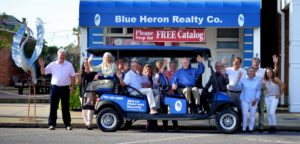
It’s so hard to believe that another year is quickly drawing to a close,  that in just a few days it will be 2012.  And after I’ve finally gotten  it down pat, correctly writing 2011 on my checks every single time,   now I have to start all over again, trying to remember to write in the correct date  ? ?    Ah, the trials and tribulations of a numerically challenged person,  twas ever thus !   On a more serious note,  this is the time of year when most folks pause and try to put aside the trivial and concentrate on what’s really important– family, friends, country.   And this year, like last,  has been a very difficult one for so many throughout our great country.   But hope springs eternal,  things are improving and I for one believe that 2012 will be a better year.  In the meantime,  we would like to especially thank our clients and customers,  all the many folks who listed or purchased property though Blue Heron Realty Co. ,  we truly appreciate your business and value your confidence in our firm.   And to you, dear reader of  this  little blog on life and real estate on the Eastern Shore of Virginia,  we hope you had some fun,  learned a bit more about our little slice  of the planet  at the corner of the Chesapeake Bay and the Atlantic Ocean and plan to keep reading in the  New Year.   So,  from Lemoin, Marlene, Montaigne, Mike, Heather,  Kay, Lisa and Nicole in our Machipongo, VA  office and from Dave,  Eva,  Jennifer, Luisa,  Bonnie and Sandy in our Cape Charles, VA  office,  thanks ever so much !    Have a wonderful holiday season and best wishes for a happy, healthy and prosperous New Year from the entire Blue Heron Realty Co. crew !  

“Echoes Of The Past”– The 16th Annual Holiday Progressive Dinner In Cape Charles, VA

December 22nd, 2011 by Marlene email

Every year for the last decade and a half, the Northampton County VA Chamber of Commerce has sponsored a wonderful holiday event– the Holiday Progressive Dinner in Cape Charles, VA  (although the 2010 Dinner was held in Eastville, VA ).   This delightful event features a “soup-to-nuts”  meal progressively served at about 10 historic  Victorian homes and sites throughout the town.   The Chamber outdid itself this year by including  even more entertainment — seven theatrical vignettes recreating a visit in 1886 to Cape Charles by US  President Grover Cleveland  were added to the normal fare of excellent food and musical entertainment. Eldest Daughter, Middle Daughter,  a friend and I had tickets for the earliest group, the “Santa Group”,  with a kick-off  time of 3:30 at  Art’s Enter’s Palace Theater.  There we received our red badges, programs and started off with the evening’s first appetizer, a chili-glazed beef  kabob with Virginia peanut dipping sauce.   Then, a quick and easy walk  to Site # 2, the Bay Creek Railway Car, a fully restored vintage car originally used between 1915 and 1940′s, where  Vignette # 1 began,  a  cordial conversation between Alexander Cassatt  ( brother to the famous painter, Mary Cassatt) and Wm. Scott, founder of Cape Charles, as they prepared  to board for a railroad  trip from Cape Charles to New York.   Then,  boarding the railway car ourselves, we sampled our second appetizer, a rich Scottish smoked salmon with tomato aioli and creme fraiche, served on dill focaccia,  prepared by Aqua Restaurant.  Although I am not a huge fan of smoked salmon, this was moist and melt-in-the-mouth luscious, a 4 star.

Next,  a walk to the fully restored vintage 1950′s ranch home on Monroe Avenue owned by Tom and Kathy Bonadeo for the pasta course. a pasta primevera in alfredo sauce, prepared by Little Italy Restaurant.  The pasta was accompanied by sparkling cider or nice local wines from Holly Grove Vineyards in Franktown,VA   and the very pleasant musical entertainment by Sarah Scott, flautist.

From there  we were off to another home on Monroe Avenue, the well-known Kellogg House, a Flemish bond brick Colonial Revival, definitely one of the finest homes ever built in Cape Charles. Vignette # 2, starring Blue Heron’s own David Kabler,  told the story of  the exciting news of President Cleveland’s impending visit. Afterwards, a broth-based vegetable crab soup prepared by Machipongo Clam Shack was served,  piping hot and very tasty, quite welcome after our little jaunts around town.

Off next to  the newly opened Fig Street Inn,  located at the corner of Tazewell Avenue and Fig Street.   Originally built by one of Cape Charles’ prominent families, the Wilson family, owners of the town’s first department store, this home is located on land purchased from the estate of Cape Charles founder, Wm. Scott. The house needed substantial renovation when purchased by the current owners and they have done a marvelous job, it looks just resplendent  dressed in its holiday finery.  The Vignette here starred  Trina Veber  ( AKA Mrs. Santa from the Grand Illumination presentation) and  Linda Spence,  society ladies getting ready to meet their husbands and hear more news about President Cleveland’s  Cape Charles visit.  Afterwards,  a salad course of mixed greens with almonds, feta and cranberries was served, tossed with a tangy apple cider dressing,  everything crisp and tasty, prepared by the Exmore Diner, an Eastern Shore landmark.

From the Inn, a quick walk  up Tazewell Avenue to the home of  Mr. and Mrs. Dan Dougherty, built on land purchased directly from  Wm. Scott in 1883.  This lovely home still retains one of the original hitching posts remaining in Cape Charles and lo and behold,  a real live horse, a miniature, was hitched there, quietly nibbling at the grass and in general ignoring all the fuss around it.  Wines from Chatham Vineyards, a fine local winery, were served with a trio of cheeses and apple  slices in a pretty presentation  from  Gull Hummock Gourmet Market, located in in downtown Cape Charles,  after the Vignette which featured  Thomas Dixon and Wm. Fitzhugh, both prominent in Cape Charles society, planning a hunting trip out to our Barrier Islands which would likely include President Cleveland.

And a zip-zip across the street brought us to the beautiful Tazewell Avenue 1920′s home of  Mr. and Mrs. John Schulz. Mr. Schulz , a former Navy pilot, employee of Voice of America and foreign correspondent has many unique art pieces from around the world which he was kind enough to expound upon for our group.  After a tour of the home we were treated to music of the season played by the dynamic duo of  Malcolm, on violin,  and Carol Russ, on accordion.  It’s always a treat to be nearby when Malcolm and Carol play.  ( In fact,  they added greatly to the ambiance of  Blue Heron’s period- attire party aboard the tall ship Kalmar Nychol this past June. )  The  entree’ was served here,  a succulent  presentation of braised duck in a port wine reduction accompanied by goat cheese mashers and asparagus spears,  expertly prepared by Kelly’s  Pub located on Mason Avenue in historic downtown Cape Charles.

And last but not least,  dessert at Heyward Hall,  individual apple rum cakes, expertly  prepared by Amy B. Catering,  served with aromatic coffee brewed by the Eastern Shore Coastal Roasting Co., both enjoyed while being entertained by the mellow harmony of  Eastern Shore’s own  Acclaim Barbershop Quartet.  And then who should stride out on the stage to deliver a strong  “thank-you for your hospitality” speech ??   You guessed it,  the final Vignette of the evening featured President Grover Cleveland  congratulating the gathered Cape Charles citizens on their vision and foresight in developing the railroad and planning for the new steamer which would carry passengers and rail cars across the Chesapeake Bay.   With that speech, the  2011 Progressive Dinner Tour concluded for the “Santa Group” although about 10 or so later groups, presumably named after his reindeer, were wending their way through.   It was a lovely night, the food was great, as was the entertainment– and we managed to work off  at least a few calories as we strolled from site to site on a beautiful December’s evening.

Our Annual Carter Mountain Trek- From Virginia’s Eastern Shore To The Blue Ridge Mountains In About 3 Hours

December 22nd, 2011 by Marlene email

World Famous Chesapeake Bay Bridge Tunnel

Westward Ho !  ,  the theme of our annual trek  some weeks ago from our beloved Eastern Shore’s sandy seashore to the foothills of the Blue Ridge mountains in Charlottesville, VA.  It’s a trip that, depending on traffic,  only takes 3-4 hours,  but it’s a trip that shows off  the real beauty and diversity of  Virginia geography as we drive from our saltwater-dominated Atlantic coastal plain through the Virginia’s rolling plain Piedmont area, ( think Williamsburg, Richmond, etc. ),  and then into the gorgeous Blue Ridge area of Charlottesville and Roanoke.

A View From Carter Mountain, Charlottesville VA

( Westward still would place  you in the Appalachian Mountains and Virginia’s  famous Shennandoah Valley, very beautiful yet somehow we seldom go that far. )  Virginia certainly isn’t an especially large state but it has a diversity which makes getting a change of pace and scenery easy and fun to do.  For some reason,  it never ceases to amaze me that I can be driving on the Chesapeake Bay Bridge Tunnel, watching rolling  waves and seabirds just after breakfast and by lunchtime I can be sitting in a chair atop Carter Mountain,  munching a juicy York apple.

Michie Tavern, ca.1784, A National Historic Landmark

This year,  because of an especially busy schedule,  for the first time,  we made  our Annual Apple Trek after Halloween rather than before, which like most things in life had its pros and cons.  Pros were that it was quiet,  no lines to pay for apples and Carter’s fabulous fresh-pressed apple cider,  easy to find an attendant to get questions answered and a chair was immediately available  to sit and admire the wide vistas.  Cons– well, I really missed seeing all the kids running around trying to choose their Halloween pumpkins,  the hayride wagons full of  excited parents and kids,  the bluegrass fiddles and banjos.   In short,  apparently it wasn’t just about the crunchy apples and the beautiful vistas from atop Carter’s Mountain, it was also very much about the infectious  atmosphere of their month long October Apple Festival accompanied by the mouth-watering aromas of fresh apple pies and apple cider donuts  wafting through it that we had been enjoying all these years.  At any rate, before venturing up to the Orchard we enjoyed  a late lunch at Michie Tavern,  located right at the foot of the mountain and only a half mile from Jefferson’s Monticello.  Built in 1784 as a country inn to accommodate travelers of the day, it is a beautiful structure, a National Historic Landmark, very well-preserved. Serving a menu of foods typical of the time and still popular today– fried or baked chicken and excellent southern style  pulled pork BBQ,  accompanied by black-eyed peas,  stewed tomatoes, beets, cole slaw, mashers, cornbread, big, fluffy biscuits, etc. ,  Michie Tavern gives an authentic taste of  what travelers of the time would have experienced.  Lunch can be eaten  inside or al fresco  on their screened porch overlooking the propery’s magnificant woodlands or by the roaring fireplace in winter,  it’s always a very pleasant experience.  (www.michietavern.com)

So Many Apples, So many Choices At The Carter Mountain Orchard

Lunch over, up  Carter Mountain we went.  The apples were great,  as usual.  We normally buy a bushel each of four different varieties, typically Stayman Winesap, York, Fugi and Pink Lady,  so that we can mix them together and give them as little  “happy-apple-harvest”  gifties to friends and family.  A Pink Lady is an especially pretty apple, a very pale green with a large blush of deep pink on the side,  quite crisp and slightly tart, one of my favorite apples, both a good eating and a good pie apple.   But for applesauce, I think you just can’t beat the combination of  the Stayman and  York varieties with a few Fugi and Macintosh thrown in for good measure.   At our house we love applesauce, unsweetened, chunky, flavorful,  lightly laced with cinnamon,  completely delicious with chicken or pork, and, I might add, so good for you.  It’s hard to tolerate what passes for applesauce in the supermarket, thin, grainy, absolutely flavorless– must be made with mealy red delicious, the worst apple ever for flavor.  But a big pot of  three or four  types of  sweet-tart Carter Mountain apples, slowly simmered with a little apple cider,  mashed carefully to retain some chunks  (but not too  many), gently flavored with cinnamon and perhaps a tiny dash of clove at the very end — now that’s an applesauce that we will drive 3 hours to get really fresh apples to make !  ( By the way, applesauce freezes very well, pull it out, defrost and it tastes almost as great as the day it was simmered off in the big apple kettle.)   So we got some  great apples, newly  picked that morning,  we got the fresh-pressed apple cider, delicious either hot and mulled or icy cold,  as well as a dozen pre-packaged cider donuts.  All in all,  we had a great day.  But …..  for Apple Trek 2012,  I think we will make a point to go before Halloween so we can enjoy all the extras too — the yelling kids, the noisy hayrides,  the bluegrass band twanging away and the aromas of apple pies newly baked,  all the many features of the October Apple Festival atop  Charlottesville’s Carter Mountain.
Carols, Candles And Sleigh Bells Marked The 2nd Annual “Grand Illumination” At Central Park In Cape Charles, VA

December 9th, 2011 by Marlene email

It was a beautiful  Eastern Shore night for the Cape Charles 2nd Annual  “Grand Illumination”,  moon nearly full,  skies clear, stars shining down brightly on the event, temperatures in the mid-40′s,  cool-ish but  not cold.  ( Unlike last year at the 1st Annual  “Grand Illumination”  where  the wind was a little  brisk– I was  sorry I hadn’t brought a pair of gloves and worn a warmer blazer, finding myself doing  jazzercise steps to keep warm —  jingle bells, stomp-stomp-stomp,  jingle bells, stomp,stomp,stomp– you get the picture.)   Running a bit late, I  threaded  through the gathered crowd of  happy youngsters, oldsters,  teenies and toddlers,  to find Daughter #3,  daughter- in- law  # 1 and four grandkids who fortunately had already located good viewing spots near the front of  The  Gazebo at Cape Charles’  beautiful Central Park.  Caroling was just beginning,  kicked off by the  Master of Ceremonies,  Chris Bannon of Seagate B&B,  dressed in a bright red Santa hat and wrapped in a big holiday smile.

Dedicated  in September, 2010, the Cape Charles Central Park,  with its wide green, gracefully curving sidewalks, lovely fountain,  dozens of  Memorial Trees, elaborate children’s playground and The Gazebo,  is the glorious result of years of collective effort by the many, many volunteers of  ” Citizens For Central Park”  and  nearly a million dollars in  donations and grants.  It’s now the pride of  the little coastal town of  Cape Charles,  the site of  public events large and small,  a place for  individuals and families to enjoy a walk,  a jog,  a frisbee contest on a summer’s eve.  And now,  for the holidays,  it’s a magical place of trees and old-fashioned Victorian style lamp posts strung with thousands of  twinkling lights, colors galore and blazing white, a feast for  the eyes,  a sight for every passerby to enjoy as they light up the night.

Meanwhile,  back at  The Gazebo, folks were still arriving,  strolling down the Park’s  curving paths,  now lined with luminaries glowing brightly in the  darkness,  twinkling like little stars  fallen to earth,  everyone receiving  a candle .  Up on stage,  Santa and Mrs. Claus  ( a big shout-out  to Larry and Trina Veber, long time  Cape Charles residents,  for all the time they donate to make so many great local events even better),  gathered with the Mayor, the choir, some members of Cape Charles Town Council, Cape Charles Chief of Police, Commander of the Cape Charles Coast Guard Station as Chris Bannon gave a memorial tribute to Melvin Dudley, without whose tireless efforts  Central Park would not be what it is today.   In fact,  a beautiful red cedar has been been planted in a place of  honor near the playground as a Memorial Tree for Melvin Dudley and has been  designated as the now and future Official Christmas Tree  of Cape Charles.  Its plaque  reads: ” In honor of his dedication to Cape Charles, his gifts of wisdom,  his grand sense of humor,  his love of family and appreciation of the beauty of this environment.”  Then, a  flip of the switch and the Melvin R.  Dudley Memorial Tree  burst into brightly glowing colors, the first  tree to be illuminated.  As  dignitaries came down from the stage to  light the candles of those gathered below, golden flickers spread  until hundreds of candles glowed in the darkness, spreading light and good cheer as  carols continued to be sung and smiles contined to grow.   ‘Tis  after all,  The Season.  Then the big moment- Mayor Dora Sullivan asked everyone to blow out their candles  and turn towards the Park Green.  As they turned,  the entire Park leapt into color, everywhere trees and lampposts  glowed and twinkled  as thousands of points of  shining lights  enveloped Central Park in a brilliant blanket  of  sparkling luminous energy, evoking a wave of applause from the crowd as the 2nd Annual  “Grand Illumination”  was concluded.                                                                             

Time then for visiting with Santa and Mrs. Claus who had flown in straight from the North Pole just for this event !   Kids large and small lined up for a shy chat with Santa and a big hug from Mrs. Claus. It was really sweet and so authentic,  The Gazebo wreathed in brilliant blue lights, Santa and Mrs. Claus in bright red,  kids waiting patiently in line for a chance to whisper into Santa’s ear their deepest holiday wishes,  phone cameras clicking as parents snapped pictures,  reindeer nickering  just a few feet away,  their bells jingling gaily.  Well, not exactly reindeer,  actually more like horses…. but they definitely were nickering  and their manes were entwined with ribbons and little bells which jingled gaily at every toss of their bedecked  heads. 
Thanks to the folks from the Triple M Ranch,  a 150 acre horse farm with winding  riding trails located just outside Cape Charles,  6 beautiful and patient horses and their  riders had gathered  at the entrance to Central Park so that kids of all ages, including myself, would have  a chance to pat  and talk to them. ( Check out Triple M at  www.triplemranches.com )  My youngest grandson, who is a bit awed by horses,  just loved seeing them all dressed up in their red and green holiday finery.  He even ventured a gentle stroking  of the neck  of  a small filly. What an unexpected treat,  it brought a real old-fashioned holiday flair to this  great small town event,  hope to see these reindeer, I mean horses,  again next year at Cape Charles’  3rd Annual “Grand Illumination” !
Charlottesville Uncorked– A Fall Week-end Sampling Blue Ridge Mountain Area Wines

December 1st, 2011 by Marlene email

Just before Thanksgiving we had an opportunity to take a week-end off  and decided to make a quick trip  to Charlottesville, VA.   Located at the foot of the  beautiful Blue Ridge mountain range, it’s only about a three and a half hour drive from the Eastern Shore of Virginia and it’s a drive through some of  Virginia’s prettiest countryside,  ever gorgeous in the fall.  We started out by heading south over the Chesapeake Bay Bridge Tunnel, deep blue waters of the  Bay glistening in the sun,  picking up Rt 64 west to Williamsburg, which is a lovely tree lined drive through slightly hilly terain,  a quick stop at the Williamsburg Outlet Mall for a pair of boaters at Bass Shoes,  lunch at the  Cheese Shop in Merchant’s Square in the Colonial historic area,  one of their delicious Virginia country ham sandwiches accompanied by a  little glass of chilled white wine.  Back on the road again, by-passing Richmond, heading  into even more rolling terrain until suddenly, from the top of  a  hill,  the  peaks in the distance now reveal themselves in varying shades of blue, the Blue Ridge Mountains,  a lovely sight, and then we’re  quickly in Charlottesville.

Charlottesville, C-ville, as residents call her,  is best known for  three things.  1.)  It is the home of  UVA,  the University of  Virginia, which in 2011 once again maintained its top rating,  tied with UCLA  as the 2nd best public university in the entire nation.  2.) It is the location of  Monticello, the exquisute mountain-top estate of the 3rd president of the United States,  Thomas Jefferson, and a named UNESCO World Heritage site and 3.) It is home to Ash Lawn, home of James Monroe, 5th president of the Uunited States.  And as if that were not enough,  among others,  it is also the  home of  author John Grisham and  Dave Matthews of the Dave Matthews Band !

A word, or 2, about UVA.   Its  gorgeous campass,  with mostly classically styled  buildings nestled into a rolling terrain,  is sited on 800 acres of  land which had been part of a 3000 acre parcel owed by James Monroe.   The original concept of the University came from Thomas Jefferson, who rated his work in designing and establishing it as the primary achievement of his life,  more important even than his presidency.  The most revered building at UVA is its first building,  the Rotunda, designed by Thomas Jefferson himself,  a beautiful classical design modeled after Rome’s  Pantheon.  Fully completed only after Jefferson’s death, the Rotunda became the academic village that Jefferson had envisioned, containing the library, classrooms, faculty offices and student rooms.  Now, of course, the University is a huge affair, with an enrollment of  over 21,000 students  and a faculty of  nearly 1400– I’m sure that Jefferson would be tremendously  proud of all that has been accomplished by his successors in the last nearly 200 years.

Sunday morning,  after a relaxing brunch at Maya’s on Main Street in the C-ville’s quaint little downtown ( highly recommend the potato cakes with smoked salmon ), we set off for a day of exploration and wine tasting.  As it turned out, there was more exploration and less wine tasting.   Having driven by Ash Lawn, the home of president James Monroe, many times we decided that the time had finally come  to stop and take the tour– and so we did.  ( A little trivia on US presidents– 8 were born in the state of Virginia and 7 are buried in Virginia including  both Jefferson and Monroe.) Monroe purchased  an estate of over 3500 acres ( including the 800 that went to UVA)  adjacent  to Monticello  where his close friend Jefferson lived.  Jefferson helped Monroe select the exact location to site his future home which Monroe named Ash Lawn-Highland when it was completed about 1800. Although Monticello is a very grand home,  Monroe went in the opposite direction and built a very tasteful but much smaller home which he referred to as his “cabin castle” in the country.

The property is a now a museum owned and operated by the College of William and Mary, with house and grounds very much as they were in Monroe’s day– formal flower gardens,  a large working veggie and herb garden, numerous out buildings including the barn, icehouse, smokehouse, etc., pastures with cattle grazing, all overlooking the beautiful mountains.  It was a most interesting tour with a few bits of  great trivia: back in the day wallpaper was extremely expensive and so was not actually glued to the wall as it would be today but rather attached by tacks so that if the owner moved the wallpaper could be packed up along with the other household furnishings.  Also, Monroe was the very first president to commission his own presidential china for use during his term in the White House- prior to that  presidents  were  expected to bring their own china  Washington with them. And of course since that time ever subsequent president has commissioned his own china pattern for official White House use.  But the most interesting couple bits  of Monroe triva offered by the tour guide were  that in the very famous painting  of General George Washington crossing the Delaware, then Lieutenant Monroe is shown in the boat standing  just behind  Washington, holding the flag.  However,  at the time  Monroe had actually already reached the New Jersey shore in an entirely different boat from Washington.   And talk about making a fashion statement, a replica of the deep rose colored wedding gown worn by Monroe’s glamourous wife, Elizebeth, stands in the drawing room,  made notable by the fact that has no buttons, snaps or fasteners of any kind whatsoever — she was literally sewen into the dress for the ceremony after which the dress was taken off by re-opening the seams !

From Ash Lawn we were off to the new winery acquisition by  “The Donald”.  The former Kluge Estates Vineyard is now  called Trump  Winery, no surprise there although the primary  wines for sale are  ’07,  ’08, ’09 and  ’10  bottlings  which still carry the Kluge label.   The tasting room is very much the same, still  attractive warm woods but an additional large outdoor seating area has been added in the back and a large screen TV in the main room offers a beautiful slideshow of the vineyard through the seasons. Sparkling wines were very much the signature wines of Kluge and I’m sure will be of Trump as well.  We ordered a small cheese plate and tastings of  all 3 of the sparklings, a Blanc de  Blanc,  Blanc  de Noir and the Rose’,  favorite hands down being the elegant  and beautifully colored  Blanc de Noir.

From Trump it was on to the only other vineyard we had time for, Jefferson Vineyard,  just a few minutes away from Monticello. It is well-known that Jefferson became a great connoisseur of wine  from the substantial amount of time he spent in France  when he succeded Franklin as the  American ambassador.

Jefferson was eager to establish vineyards on this side of the Atlantic and the land on which Jefferson Vineyards stands was at one time owned by by an Italian viticulturist who was prompted by Jefferson to try his luck in Virginia.

On Resolute Wings- Celebrating Birds And Birding At The 19th Annual Birding Festival on The Eastern Shore of Virginia

November 17th, 2011 by Marlene email

Eastern Shore Migration Paths

The importance of the Eastern Shore of Virginia as a feeding and rest area for migrating songbirds and raptors as they travel south down the Atlantic Flyway cannot be over estimated.  Because birds need to catch their breath,  rest up and chow down,   before flying over large spans of open water the beautiful southern tip of  the Virginia Eastern Shore  serves as  a Howard Johnson’s  for birds– pleasant motel plus 24 hour full service restaurant.  ( I know I’m dating myself here but as a child I loved  their fried clam strips and  awesome Indian pudding, not that anyone knows about Indian pudding anymore, and of course Howard Johnson’s has been gone for a thousand years. )  As the birds funnel down the ever-narrowing peninsula  by the thousands each fall,  flying south for the winter, flock after flock between September and November,  the habitate and food resources available in our southern tip, from Cape Charles south to the Bridge-Tunnel become critical to these birds,  life or death even.  And fortunately for these beautiful feathered creatures,  Kiptopeake State Park,  with its unique coastal habitate and ample food supply,  is ready and waiting for them.  And for over 30 years, long before it became a state park,  an important bird banding program has been on-going at Kiptopeake with over a quarter of a million birds banded in that time.

Examining And Measuring Songbirds Being Banded At Kiptopeake State Park

The bird banding program is so interesting, kids and adults alike are  just fascinated by the process.  Nets constructed of a nearly invisible mesh are placed at strategic points throught out the  Park’s wooded areas and then checked by volunteers every half hour or so.   Usually several birds have been caught in the net and these are carefully disentangled by the volunteers and the birds brought into the banding station for a careful examination.  The volunteers have data charts on which they measure and note such items are age, sex, fat, body molts, wing molts, skull size, etc., etc. for each bird that is banded.                       

Eastern Shore Butterfly Migration

And from the banding program and the interest of many groups including US Fish and Wildlife and the Virginia Department of Conservation and many individuals the concept of a Birding Festival was born and has been gaining strength ever since,  adding additional activities each year for Birding Festival attendees to enjoy.  In addition to all day demonstrations of Bird Banding and various Hawk Observatory programs at Kiptopeake Park,  this year some of the many other activites included  Butterfly Walks at both the Virginia National Wildlife Refuge and Kiptopeake Park, with the expectation of possibly seeing up to 60 + species of butterflies and skippers as they migrate  through,  several Owl Prowls during the evening hours at both the Refuge and the Park,  a Barrier Island Walk  at Fisherman’s Island, home to many waterfowl, shorebirds and wading birds,  A hike through the Savage Neck Dunes Preserve  which has a mile of  Chesapeake Bay shoreline as well as the highest dune on the Eastern Shore and a hike at Wise Point, a pine forest located at the very, very tip of the Shore.

The Popular "Touch and Feel" Tank From The Virginia Marine Science Museum

Water related activities included eco-tours by Broadwater Bay Ecotours leaving from both Willis Wharf and Watchapreague,  getting a duck’s eye view and exploration of our pristine seaside salt marshes, mud flats and open waters, look for seabirds and shorebirds. For kayak lovers there were three wonderful trips, the Cherrystone Creek Kayak trip and the Chatham Vineyard’s Kayak and Winery Tour to see wading birds, osprey, etc. and the Wildlife Refuge Kayak trip along the Virginia Inside Passage, home to osprey, plovers, egrets and herons among others. And this year, for the more adventurous, a Stand Up Paddleboard Trip from the Wildlife Refuge. Paddleboards are billed “as the coolest craft on the water”  and apparently are a great way to do birding, certainly sounds like a lot of fun.  For the less adventurous but also interested, a variety of exhibits and demonstrations take place at the Cape Charles Fire Station including a “touch and feel”  aquarium tank  exhibit from the Virginia Marine Science Museum,  perfect for kids of all ages.  In short, this Festival is a wonderful event for everyone  who is interested in having fun while celebrating birds and birding.  For  information on the upcoming 2012 Birding Festival  on Virginia’s  Eastern Shore,  keep updated by visiting    www.esvafestivals.com .

The Exciting Sights And Sounds To Be Savored When Crossing The Chesapeake Bay Bridge Tunnel

November 10th, 2011 by Marlene email

A few  weeks ago,  David Kabler, broker for Blue Heron Realty Co.’s Cape Charles, VA branch office,  wrote an  interesting post about an unusual tour he and other members of the Cape Charles Coast Guard Auxillery were priviledged to be able to take of the inner workings of the Chesapeake Bay Bridge Tunnel complex which connects the Eastern Shore to the Virginia Beach/Norfolk area of mainland Virginia.   Dave’s post was primarily about the interesting things the group learned about the history, construction and operation of this amazing structure, known far and wide as one of the great engineering marvels of the modern world.   Like Dave,  I too have traveled  “The Bridge”  countless times, on the old single lane span and the new double lane span,  in good weather and bad,  during the day and in the middle of the night,   “going across the Bay”,  the old Eastern Shore colloquialism,  a throw-back to the days when traveling  for several hours by ferry was the only way to cross these wide waters, a significant trip for sure.  People didn’t say they “were going to Virginia Beach”,  they said “I’m going across the Bay” and that native phrase is as alive and well today as it was 50 years ago.  I love traveling on this Bridge, for reasons too numerous to count, but let me give it a try.

My family and I have lived on the Eastern Shore of Virginia  for over 25 years.  We love it, wouldn’t want to live anywhere else,  we treasure the Shore’s beautiful lands, the relaxed pace of life,  its friendly people.  But I also love the shopping malls,  the numerous special events,  the art  institutions like Norfolk’s Chrysler Hall and Harrison Opera House as well as the numerous restaurants featuring cuisines from all over the world,  all  to be found less than an hour away  in Virginia Beach and Norfolk.  And then there are the  points further west but still within a 2-4 hour’s  drive of the Eastern Shore,  fabulous and historic cities  like  Williamsburg,  Richmond,  Charlottesville and Washington DC,  all of which  which we visit for one occasion or another at least several times a year.  In fact,  we  just got back from a week-end trip to D.C. and Richmond last month and are planning to make our annual fall   “apple trek”   to Carter’s  Mountain in Charlottesville later this month.   So the Chesapeake Bay Bridge-Tunnel  is our easy, fast,  safe and truly beautiful connection from our splendid low-key, relaxed cocoon here on the Eastern Shore to the wider, faster, ultra busy-busy  world on the other side of the Chesapeake Bay, our tether to a metropolitan lifestyle but  “on-demand”,  our demand.   It’s  a lifeline from one set of  interests to another,  a  way we Eastern Shore residents  have found to have  our cake and eat it too,  a time machine,  enabling the traveler to emerge  smiling from one type of world into another —-  in less than an hour !

Not only does the Bridge allow the practical physical connection of our slender peninsula to the Mother Ship of mainland Virginia,  from an aesthetic point of view,  the Bridge itself  is a beautiful sight to see  and the sights and sounds of a trip on the Bridge are extraordinary.   The 17 mile crossing point is placed approximately where the Chesapeake Bay and Atlantic  Ocean merge so it’s like traveling over a water wonderland,  seabirds  swooping and calling overhead,  flocks of pelicans skimming over the waves,  that little flock of cormorants usually perched on the railing outside the second tunnel or  what seem to be billions of chattering gulls, diving madly into the water to take advantage of a passing school of  menhaden.   In summer sometimes we’ ll be lucky enough to see a school of dolphins jumping — this area is the nursery ground for  the bottlenose dolphin.  The Eastern Shore is a critical part of the Atlantic Flyway and autumn brings sights of  large bands of migrating songbirds and raptors  swooping gaily through the skies or taking a break in the sanctuary of Fisherman’s Island ( seen  just as one gets on ( or off)  the main span ).  In winter we keep our eyes peeled for the small number of  humpback whales that  migrate through between December and March but  have never been fortunate  enough to see one,  still hoping though.  

Large tankers traveling the Baltimore Channel on the horizon,  sailboats and power boats  crusing along, doing their fishing or crusing thing are a common but nevertheless, interesting sight.  Sometimes, if you’re lucky,  near the south tunnel you’ll see  one of the  destroyers  or a submarine, maybe even a huge hovercraft,  from Navel Station Norfolk,  one of the Navy’s largest  U.S. bases, traveling through the  open navigation channel for large ships at  Thimble Shoal Tunnel, the south tunnel.  Once we happened to be traveling on that section of the Bridge just as the aircraft carrier USS Enterprise  passed through,  deploying for the Middle East.  She is quite an impressive  sight.   And a couple of months ago,  for the first time ever,  I saw a helicopter carrier ship which had just passed  through the channel,  going east– I pulled over at the special viewing area on the tunnel’s 5 acre manmade  island to watch for a few minutes and saw flying out,  one by one,  to land on her deck,  about  8 helicopters, no doubt deploying to some faraway part of the world,  leaving home and family behind in Virginia Beach.   And  quite frequently we see  huge cargo ships up close,  loaded with containers to be off-loaded at Norfolk Terminals.  From time to time we’ve seen ocean liners  passing through the channel over the tunnel,  headed to the  Cruise Ship Terminal next to  Nauticus Museum in Norfolk,   these ships passing in the night  are especially pretty,  lights blazing from long rows of  portholes.  There’s  always,  always something interesting going on as one travels  “across the Bay”.


When you first get on the Bridge  you cannot see  the land on the other side,  you are just suspended above  what seems to be an endless expanse of  water,  blue and glistening on a sunny day,  deep pinks and violets when traveling at sunset,  very, very  special  on full moon nights,  the  golden-white moonbeams casting a long trail across dark  waters,  a perfect  illustration for the nursery poem  ” Winken,  Blinken and Nod”,  as they sailed  off into a river of crystal light with the glorious stars above,  one of the most beautiful times to be on the Bridge.   And in my estimation, one of the prettiest sights you’ll see on the Shore is the  gracefully curved shoreline of  Fisherman’s Island Wildlife Refuge on a sunny day as viewed  from the top of the homeward bound north span’s  high level bridge,  the sparkling blue waters,  waves breaking on  the shore,  lacy white sea foam,  the  glistening  white sands,  green beach grass,  the infinite waters of the Atlantic beyond, ….. well,  ” mid  pleasures and palaces though we may roam, be it ever so humble, there’s no place like home !”   And the Bridge is our faithful conduit from pleasures and palaces back to our Eastern Shore home, sweet, sweet  home.

“Singing In The Rain” Redux- Our Fabulous Weather On Virginia’s Eastern Shore

November 3rd, 2011 by Marlene email

I was just sitting at my desk  last Saturday morning, rain drumming on the office roof, working on a little overdue  project,  feeling just a teensy bit sorry for myself  because we cancelled our trip to Carter Mountain Orchard in Charlottesville, VA ( www.cartermountainorchard.com ) because heavy rain was forecast for most of the day and I don’t like to drive in a downpour.  But I started feeling cheerier when one of our agents got a call from a customer who will be closing shortly on a home they just  purchased here on the Eastern Shore of Virginia , saying they were absolutely getting  hammered by snow,  falling  like  crazy  outside their home  overlooking  the Hudson River near New York City.   Snow in October, I  thought.  Wow, what a bummer  !   October is for enjoying fall foliage, driving to apple orchards,  sipping sweet-tart apple cider out on your deck on a beautiful fall afternoon or visiting  wineries to taste the new releases.  October is definitely NOT supposed to be for slipping and sliding on icy roads,  shoveling sidewalks or salting  down the front steps.   Or,  worst of all,  having your power off for days on end as proclaimed on the front page of the New York Times that Sunday– “  Storm Leaves More Than 2 Million Without Power”.

Which brings me full circle once more to “Singing In The  Rain”  here on the  Virginia Eastern Shore.  Like last year, and the year before, and the year before that,  and indeed most of my nearly 25 years here,  when areas just north of us are being lashed by sleet, snow and high winds,  here on the Eastern Shore,  we are enjoying rain.   “Enjoying”  in the sense that it’s great to have  woods, fields and ponds  getting a good drink and water tables  being refilled — even though we might cancel trips so as not to have to drive  in heavy rain.   So many benefits, so few drawbacks !   Our moderate maritime climate, our fabulous weather,  is one of the many delightful aspects of life on the Eastern Shore.  A beautiful four season climate with long, pleasant springs and falls, the hot part of summer short with cooling breezes blowing off  the water,  the cold part of winter short  and moderate ( most winter days seem to be between 40 to 50 degrees outside) – by the end of February or first part of March,  farmers normally starting  plowing for spring plantings.  For avid boaters, golfers and beachcombers, it’s terrific– you’ll see them out and about all winter long,  “doing their thing”,  enjoying  every outdoor minute of   a  refreshing  45 degree winter’s day.

So last Sunday, when we woke up here on the Shore to a beautiful Indian Summer day,  leaves beginning to turn, skies clear and blue, slight breeze, temperatures forecast to be about 65 degrees and sunny,  it was hard to imagine what it would be like to live  in parts of New Jersey with 15 inches of snow and no power,  or in New York with a state of emergency declared in 13 counties  or in parts of Massachusetts or Connecticut, buried under up to 27 inches of snow and electricity forecast to be off  for up to a week.  And I didn’t actually have to imagine it because the Weather Channel covered it all in full detail,  fallen trees, closed airports, stranded motorists, 9 dead, the whole sad story.   Then,  just as I was making  another  pot of coffee, I looked out the kitchen window to a beautiful fall sight,  called to my husband to bring my camera– out in our little woods, beyond the back lawn and overlooking the water,  was a small family of  deer,  just passing through,  about 6 of them,  stopping every few minutes to look around and sniff the air.  Deer in  shades of  tans and browns,  trees dressed in greens and hues of  reds and orange, all set against the deep blue background of  our  Chesapeake Bay inlet– that’s what October on the Eastern Shore of Virginia looks like to us.   New York  may have  “The Big Apple”,  Massachusetts may have Boston and New Jersey may have Atlantic City…. but the Eastern Shore of Virginia has fabulous weather, our glorious, beautiful,  do-your-outside-thing- most- anytime,  moderate maritime climate.  So,  once again,  it’s  “Singing In The Rain”,  not shuffling in the snow,  here on the Virginia Eastern Shore.